
Hannibal Son of Carthage: A Legendary Lebanese General
By WLCU President, Shane Geha
Considered one of the greatest generals of the ancient world, Hannibal Barca of Carthage, shares a common ethnic heritage with every Lebanese in the world today. Carthage was a Phoenician settlement and one of the largest cities in the ancient world.
Founded at the site of present-day city of Tunis, Tunisia in 814 BC by the ancient seafaring Phoenicians originating from Tyre in Lebanon, Carthage came to dominate the entire Mediterranean basin and threatened Roman supremacy, until its final conquest and destruction by the Romans in 146 BC, following Carthaginian capitulation in the Second Punic War. The Romans did rebuild Carthage however, to an even more glorious form and it remained a Roman colony until the Arab conquest of North Africa in the 7th Century.
And the greatest son of Carthage was Hannibal. Living a comparatively long life of 66 years for an ancient world soldier (247 BC-181 BC), Hannibal led the armies of Carthage in a remarkable series of successive victories against the Roman Republic, in what came to be known as the Second Punic War. In fact the name Punic, assigned to the war by the Romans, is derived from the Latin word for Phoenician.
Hannibal was distinguished for his ability to determine both his and his opponent’s respective strengths and weaknesses and is still recognised today, as one of the greatest military tacticians of all time.
His well-planned strategies allowed him to conquer Spain and to enter Gaul and then Italy, crossing two sets of mountains: The Pyrenees and The Alps and almost bringing Rome down. But his final defeat at the Battle of Zama by famed Roman general Scipio, marked the end of the Second Punic War in 218 BC, which saw Carthage conquered by the Romans, and remaining a Roman territory for over seven centuries.
Hannibal was in fact so aggrieved at Rome’s defeat of Carthage in the First Punic War, that he publicly pledged to his father that he would “use fire and steel to arrest the destiny of Rome.”
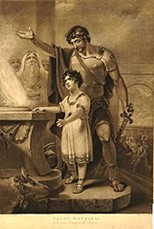
Engraving depicting the Young Hannibal by Charles Turner (1850)
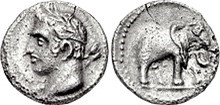
Quarter Shekel of Carthage, depicting Hannibal with the traits of Baal Melqart, the Phoenician God of Tyre and Carthage and Gadir (Cadiz, Spain). The reverse features the famed Carthaginian war elephant.
Hannibal witnessed the preparations developed in Southern Spain by his father, Hamilcar, who had already begun the subjugation of the tribes of the Iberian Peninsula (modern-day Spain and Portugal). Carthage at the time was in such a poor state that it lacked a navy that could transport its army to Spain. Instead, Hamilcar had to march his forces across Numidia (modern-day Algeria), through the Pillars of Hercules (the Straits of Gibraltar), into Hispania (Spain).
As Hannibal’s father Hamilcar went about the conquest of Hispania however, he drowned in battle and Hannibal’s brother-in-law Hasdrubal The Fair, succeeded his command of the army with Hannibal (then 18 years old) being made his deputy. Hasdrubal pursued a policy of consolidation of Carthage’s Iberian interests, endeavouring to consolidate Carthaginian power through diplomatic relationships with the native tribes of Iberia and native Berbers of North Africa. The sudden assassination of Hasdrubal in 221 BC, however, brought Hannibal, still only 26 years of age, to be Commander-in-Chief of the army, a move that proved extremely popular with the soldiers, who were still fervent about defeating Rome in battle.
In 219 BC, Hannibal’s campaign against the Romans, commenced with the siege of Saguntum on the east coast of Spain, a then-ally of Rome. The fort fell after 8 months, outraging the Romans who then declared war on Carthage, thereby marking the start of the Second Punic War against Hannibal.
Hannibal proved a master tactician. He began his preparations for his war against Rome, on Spanish soil, by wedding a noble woman Imilce of Castulo (in Andalusia), a powerful Spanish city closely allied with Carthage. In his first campaign, Hannibal attacked and subjugated the tribes around the Tagus River. His following campaign in 220 BC was against tribes to the west. On his return home, laden with the spoils of battle, a coalition of Spanish tribes, attacked Hannibal. Here he won his first major battle displaying his tactical genius at the Battle of the River Tagus in 220 BC.
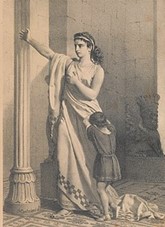
Hannibal’s Wife Imilce with son Haspar Barca (Juan de Dios de la Rada, 1868).
Rome, fearing the growing strength of Hannibal in Iberia, made an alliance with the city of Saguntum (near Valencia in eastern Spain). Hannibal perceived this as a breach by Rome of the treaty between Rome and Carthage subsequent to the First Punic War and laid siege to the city, which fell after eight months, thereby triggering the start of the Second Punic War (218 BC-204 BC).
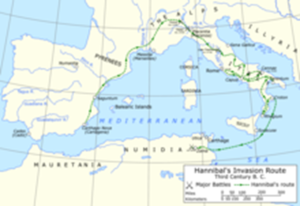
Hannibal’s Route from Carthage to Rome
Hannibal started his march in the seaport of Kart-hadasht (modern-day Cartagena, Spain) (New Carthage), overpowering with clever mountain tactics and stubborn fighting, all the tribes along his path to the foothills of the Pyrenees, in northeastern Spain, leaving behind 20,000 men to secure the newly-conquered region. Hannibal then entered Gaul (modern-day France) with 40,000 foot soldiers and 12,000 horsemen.
In the spring of 218 BC, Hannibal miraculously crossed the Pyrenees, with a formidable force of 38,000 infantry, 8,000 cavalry, and 38 elephants, and proceeded to then journey across the Alps.
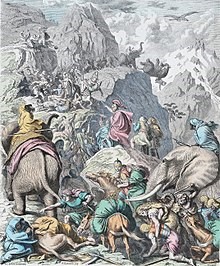
Illustration of Hannibal Crossing the Alps, Heinrich Leutemann (1866).
Hannibal masterfully outmanoeuvred all opposition in his path through Italy, with his next major victory coming at Trebbia in 218 BC, with a successful sudden attack on the Gauls, thereby separating those tribes from their ally, the Romans.
Hannibal’s forces then moved through the Po Valley, forcing the Romans to evacuate the plains of Lombardy, through his superior command of cavalry. This convinced the Gauls and Ligurians, to join the Carthaginians, bolstering Hannibal’s army back to 40,000 men. Hannibal had forced mighty Rome to retreat.
Hannibal the Master General, by skilful manoeuvres, then captured Clastidium, and resupplied his men and showed his mastery again at the Battle of Trebbia River, after devastating superior Roman infantry, with a surprise attack from the flanks.
Next came a decisive victory for Hannibal at the Battle of Lake Trasimene. The Romans, who had expected Hannibal to advance on Rome, stationed their armies at the two possible routes that Hannibal could use. Here Hannibal annihilated the Romans under Flaminius, killing or capturing all 25,000 of his soldiers. This would remain the greatest defeat ever sustained by the Romans for 150 years, until their losses at the Battle of Carrhae to the Parthians in 53 BC.
Though, after the Battle of Lake Trasimene, Hannibal had disposed of the only field force that could check his advance, he did not have enough siege hardware to sack Rome. He opted instead, to exploit his victory by entering into central and southern Italy and encouraging revolt.
The Romans had to depart from Roman military tradition, by choosing to avoid open battle, by placing only small Roman armies in Hannibal’s path, to delay his advance on the capital.
Hannibal did not want to spend the winter in the already-devastated lowlands of Campania, but Roman General Fabius had blocked all the exit passes, effectively trapping Hannibal. This led to the night Battle of Ager Falernus, which saw the great Hannibal once again outsmart the Romans, by tying burning torches to the horns of a herd of marching cattle. This deceived the Romans entirely. As they moved in pursuit of the decoy, Hannibal managed to move his entire army in complete silence through an unguarded pass. Thus, as the winter came, Hannibal found comfortable quarters in the Apulian plains of Italy, unimpeded.
What Hannibal achieved in extricating his army at Ager, became a military manoeuvre studied and replicated by army generals around the world and throughout history. It is still taught in military manuals today.
Then, in the spring of 216 BC, Hannibal resumed his campaign by capturing the Roman supply depot of Cannae, thereby cutting off the Roman Army’s main source of supply. The Romans hoped to overcome Hannibal through sheer weight of numbers, raising an army of unprecedented size, estimated at 100,000 men. They rushed to confront, one of the world’s greatest-ever generals…and they failed.
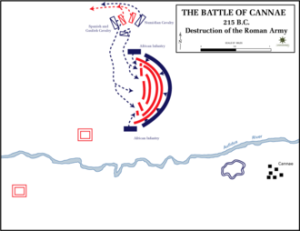
Destruction of Roman Army (Red) by Cartheginians (Blue) at Battle of Cannae. Source: United States Military Academy.
The battle tactics of Hannibal were genius. The Romans decided to confront Hannibal on the left bank of the Aufidus River and camped some 10 km away. Hannibal drew the Romans into a trap, by using a then-new “envelopment” tactic. This reduced the Roman numerical advantage, by decreasing the area of battle. Hannibal first marched his least-reliable infantry into the centre of the battlefield in a semicircle. This allowed them room to fall back, luring the Romans forward, while the cavalry on the wings dealt with their Roman counterparts. Hannibal’s flanks were composed of his best Gallic and Numidian cavalry. By getting the Roman legions to march their way through Hannibal’s “weak” centre, allowed Hannibal’s highly-trained Spanish and Libyan mercenaries on the wings, to encircle the Roman infantry.
The whole Roman Army was now totally encircled with no means of escape.
Hannibal’s Numidian cavalry then shattered the Roman cavalry and Hannibal’s Iberian and Gallic heavy cavalry, were equally successful.
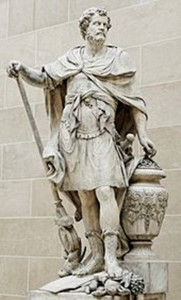
Statue of Hannibal Counting the Rings of the Roman Senators killed at Battle of Cannae (Sébastien Slodtz, Louvre 1704).
Due to battle tactics that the world had not seen before, Hannibal’s army managed to kill or capture some 70,000 Roman combatants. It was a comprehensive victory. Amongst the dead, were: Roman Consul Lucius; two previous Consuls; two Quaestors; 29 of the 48 Military Tribunes; and 80 other Roman Senators. This constituted some 30% of the entire Roman Senate, making the Battle of Cannae, one of the most devastating defeats ever suffered by ancient Rome. It is also, given the number of lives lost in a single day, considered one of the bloodiest battles in human history,
Cannae changed the Second Punic War, because after their devastating defeat at Cannae, the Romans were very hesitant to confront Hannibal again, resorting instead to attrition. Thus, the Second Punic War, saw no other major battles in Italy, after Cannae.
Following his victory at Cannae, many parts of Italy decided to join Hannibal’s cause. Rome’s allies began to waiver in their loyalty to Rome. First, the Greek cities in Sicily, were induced to revolt against Roman control. Next, Macedonia’s King Philip V, openly pledged his support to Hannibal. Hannibal also secured an entente with the newly-appointed tyrant of Syracuse.
Despite the defection of more Italian territories however, Hannibal needed reinforcements and supplies, to be able to mount a direct attack upon Rome. Instead, he launched attacks on the fortresses that still held out against him, including Capua, the second largest city in Italy, which Hannibal took and made his new base. Unfortunately, at this point, all other Italian cities were persuaded not to defect to the Carthaginians. Thus the Second Punic War campaign in Italy, had stalled into a strategic stalemate for Hannibal.
The Second Punic War, also saw the Romans develop a new war tactic: attrition. Developed by General Fabius, this had become the only feasible means for the Romans to counter the battle genius of Hannibal. General Fabius was later named Cunctator (the Postponer) because of this policy of not engaging Hannibal in battle but defeating him through attrition.
And it worked. The Romans, by depriving Hannibal of any large-scale battles, and assaulting his weakening army, with multiple smaller armies, proved successful in creating unrest amongst his troops. For years, Hannibal was forced to sustain his troops amidst a Roman “scorched earth” policy, depriving him of any local provisions, in a protracted smaller operations throughout southern Italy. Hannibal found this increasingly untenable, with his big plans now reduced to minor operations around the cities of Campania.
Hannibal’s army was thus forced to divide but his lieutenants far less able than their General. Under such difficult circumstances, Hannibal could not procure reinforcements from either Carthage, or his new ally Philip V of Macedon. Over time, his position in southern Italy became increasingly difficult and his ambition of conquering Rome, more remote.
Despite the worsening odds however, Hannibal still proved formidable, completely destroying two Roman armies in 212 BC, and killing two consuls, including the famed Marcellus in 208 BC. But Hannibal’s fortune was running out, with switched allegiances of his Italian allies, which was compounded by the abandonment of his own government. This depleted his resources to such a degree, that he was never again able to bring about another decisive victory against the Romans.
Hannibal was still not defeated however. When the Romans mounted a siege of Capua in 212 BC, Hannibal attacked them and forced their withdrawal from the whole of Campania. He then moved to Lucania and destroyed entirely a 16,000-man Roman army at the Battle of Silarus. He next annihilated a Roman army of 18,000 men at the first battle of Herdonia, leaving 16,000 Romans dead, and freeing Apulia from the grip of the Romans for the year.
Observing the status of Hannibal’s depleted troops, the Romans did however mount a successful counter attack on Capua in 211 BC, reconquering the city. In 212 BC, Marcellus reconquered Syracuse and the Romans devastated the Carthaginian Army in Sicily. The Romans then defeated Philip V of Macedon, with the assistance of Rome’s Greek allies.
In 210 BC, Hannibal again proved his superiority in tactics by inflicting a severe defeat on the Romans at the Battle of Herdonia and again in 208 BC, when he destroyed another Roman army at the Battle of Petelia. The Romans played the long game however, recapturing Tarentum in 209 BC and Samnium and Lucania. Finally by 208 BC, Hannibal’s remarkable conquests in Italy had all been lost.
Hannibal was still not dissuaded. In 207 BC, he joined forces with his brother Hasdrubal to march upon Rome. Sadly for Hannibal however, Hasdrubal was defeated and killed by the Romans at the battle of the Metaurus and the assault on Rome had come to an end.
After nearly 15 years of victories in battle, the glorious military fortunes of Carthage had finally come to an end in Italy. In 203 BC, Hannibal had to rush back to Carthage to defend Carthage against a possible attack by the Romans, led by one of their greatest-ever generals: Scipio Africanus.
Conclusion of the Second Punic War
There was much mutual admiration between Scipio and Hannibal which allowed Scipio and Carthage to negotiate a peace plan, approved by Rome. The terms of the peace were quite modest, but the war had been long and exhausting for the Romans. Carthage would retain its African territory but would cede its overseas territories to Rome. Numidia would become independent and Carthage would reduce its fleet and pay tribute (tax) to Rome.
The Carthaginians however made a huge error of judgement. Some long-suffering citizens, against Hannibal’s wishes, captured a stranded Roman fleet in the Gulf of Tunis capturing its cargo. In the middle of delicate peace negotiations, this enraged Rome. Now Hannibal found himself leading an army in a final act of defiance in the decisive Battle of Zama in 202 BC.
Unlike most battles of the Second Punic War, at Zama the Romans were superior in cavalry but Hannibal commanded larger infantry. Hannibal by now, had aged and was exhausted after 15 years of campaigning in Italy. He still had the support and respect of his troops however, and the Carthaginians had the superior numbers accentuated with 80 trained war elephants.
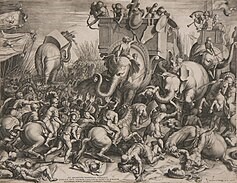
Engraving of Battle of Zama by Cornelis Cort, 1567.
Note that Asian elephants are illustrated rather than the very small North African elephants used by Carthage.
The Roman cavalry dominated early, by swiftly routing the Carthaginian horsemen and through Roman tactics for nullifying the Carthaginian war elephants, including playing trumpets to frighten the elephants into running into the Carthaginian lines. It was a very closely-fought battle. At one point, Hannibal appeared on the verge of victory. Scipio was not to be outdone however, used his cavalry to attack Hannibal’s rear, causing the Carthaginian formation to collapse. The Carthaginians had no choice but to surrender. Carthage lost 20,000 men with 15,000 wounded. The Romans had only 2,500 casualties. Thus Scipio was the victor at the Battle of Zama, which brought finality to the Second Punic War in 201 BC. For his victory he won the surname Africanus.
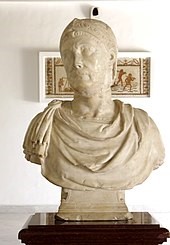
Bust of Hannibal, Bardo National Museum, Tunisia
Hannibal was only 46 at the conclusion of the Second Punic War in 201 BC, Hannibal was elected Chief Magistrate of Carthage and soon showed that he had great ability as a statesman as well as a general. The peace treaty imposed by Rome burdened Carthage with an indemnity of ten thousand talents. Hannibal quickly reacted by reordering state finances, clamped down on state corruption and recovered stolen funds.
Hannibal then passed a law limiting the power of oligarchs and stipulating the direct election of leaders. He also used citizen support to change the term of office of leaders from life to only one year. Only seven years after the defeat at Zama, Carthage now exceeded Rome in prosperity. Coupled with deep suspicions that Hannibal was forming alliances with Rome’s enemies, the Romans had decided to capture him but Hannibal fled into voluntary exile before the Romans could demand that Carthage surrender him into their custody.
He first sought refuge in Tyre, his ancestral Phoenician homeland and the mother city of Carthage. Then he fled to Antioch, before finally reaching Ephesus, where he became a close confidante of King Antiochus III, the Seleucid of Syria.
A documented story has it that Hannibal attended with King Antiochus a lecture on “the duties of a general” and when Hannibal was asked his opinion, he remarked: “I have seen during my life many old fools; but this one beats them all.”
In the summer of 193 BC, tensions flared up between the Seleucids and Rome. After having suffered a series of defeats against the Romans, Antiochus gave Hannibal military command and was tasked with building a fleet from scratch. Although Phoenician territories like Tyre and Sidon possessed the necessary combination of raw materials, technical expertise, and experienced personnel, it took much longer than expected for it to be completed, due to wartime shortages. Ultimately, the fleet was defeated by Rome and its allies, giving Rome control of the Aegean Sea.
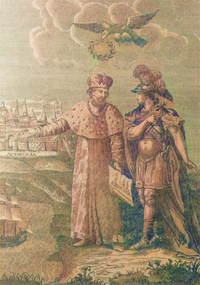
Hannibal and Artaxias I of Armenia.
Hannibal was then given protection by Artaxias I, king of Armenia, where it is alleged that it was Hannibal who planned and supervised the building of his new capital Artaxata. Hannibal then sought refuge in Crete, then in Anatolia, then aided Prusias I of Bithynia, who was engaged in a war with Rome’s ally, Eumenes II of Pergamon. Hannibal went on to serve Prusias I, commanding many naval and two land battles, all ending in victories over Eumenes. In one naval battle, Hannibal had large pots filled with venomous snakes cast onto enemy ships. Hannibal also went on to defeat Eumenes in two other battles on land. The genius of Hannibal continued.
Hannibal now so threatened the Romans, that they forced Bithynia (northwest of Asia Minor in modern-day Turkey) to hand him over. But the great General was determined not to fall into his enemy’s hands and when discovering that the castle where he was living, was encircled by Roman soldiers, chose to swallow poison than be captured. The year 181 BC would therefore lay claim to one of the greatest military leaders of the ancient world…a scion of the Phoenician Lebanese of the highest calibre.
Interesting Fact:
Hannibal legendary battle prowess caused such distress to so many Romans citizens, that he became legendary. When frightened, Romans would exhort: “Hannibal Ad Portas” (Hannibal is at the Gates), an expression conveying a need for urgent action. This expression is still used today.