
Beaufort: A Symbol of Endurance
By Charbel Moujalli
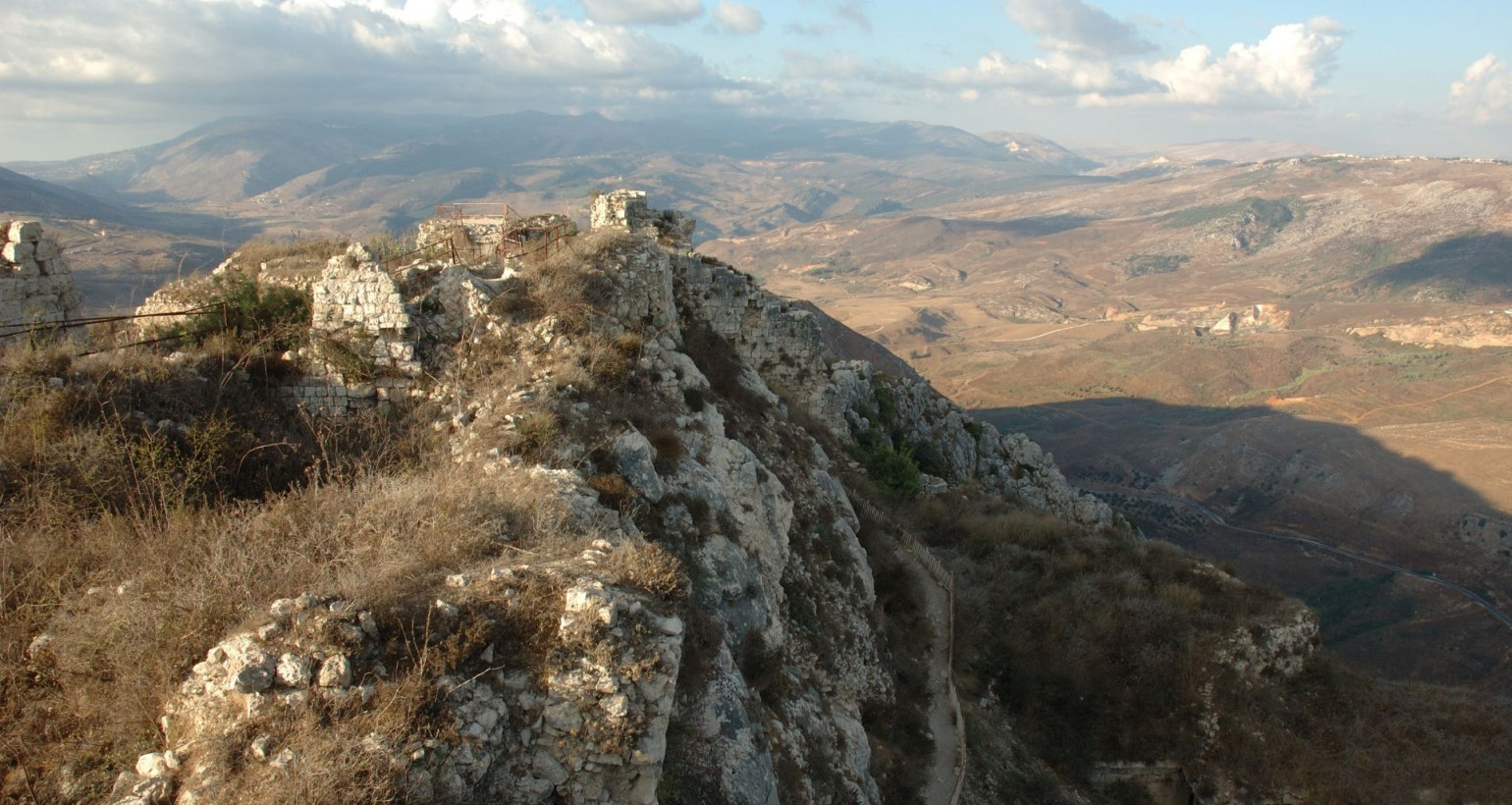
In the Nabatieh district of Southern Lebanon, a ruined fortress stands on the lip of a cliff that falls some three hundred metres to the water below. I looked upon it myself in 2018. Unlike its surrounds, the castle struck me as rather unassuming. The Crusaders who held it in the twelfth century called it Beaufort – the “beautiful fortress”. To locals, it is known as ‘Qal‘at al Shaqif’, the Castle of the High Rock. A stronghold married so completely to its escarpment that it is difficult to say where the rock ends and the walls begin.
The river beneath it is noteworthy, for the castle cannot be fully understood without it. It is the Litani, whose name folklore traces to Lotan, a seven-headed sea serpent of ancient Canaanite myth. It is the longest river that runs entirely within Lebanon, rising in the Beqaa Valley and turning west to reach the Mediterranean just north of Tyre. Throughout history, its course marked the boundaries between Phoenician, Greek and Roman authority. The land chose this place long before any wall was raised on it.
A place is not defended to such a degree unless it is worth holding.
Little is recorded of Beaufort Castle prior to 1139 A.D., though its commanding position suggests it was fortified much earlier. In that year, Fulk, King of Jerusalem, took the outcrop and granted it to the lords of Sidon, and the Crusader castle rose soon after. Its worth was proven within a couple of generations. After Saladin’s victory at the Battle of Hattin in 1187, castle after castle fell to his forces; Beaufort among the last to resist. Its lord, Reynald of Sidon, met Saladin at nearby Marjayoun and professed sympathy for his cause, asking for time to remove his family from Tyre before surrendering. Saladin granted three months and Reynald spent them repairing the walls and stocking up on supplies. Only after he was taken prisoner did the garrison finally give up the castle in 1190. A place is not defended to such a degree unless it is worth holding.
The castle changed hands as the region did. It returned to Crusader control in 1240 under a treaty negotiated by Theobald I of Navarre, was sold to the Knights Templar in 1260, and in 1268 was taken by the Mamluks. Afterwards, centuries of quiet ensued. Under Ottoman rule from 1516 it passed to local Shiite families and briefly into the network of the Druze emir Fakhr al-Din II, whose defeat cost the castle its upper works. Jazzar Pasha, the governor of Acre, besieged and slighted it further in 1782, and the Galilee earthquake of 1837 completed the ruin. For a time, the fortress served as little more than a quarry and a shelter for sheep.
Eventually, scholars and travellers returned attention to it. Surveyors mapped the ruins in the 1880s. In 1909, a young Lawrence of Arabia, walking through the region for his university thesis, was struck above all by the view from the walls – the coast on one side and the Litani threading away on the other. In the 1930s, the French medievalist Paul Deschamps cleared the inner enclosure and made the careful record of the castle that later historians would come to rely on, precisely because the building he drew was, in time, damaged almost beyond recognition.
That damage came because Beaufort is one of the rare medieval castles whose military value survived into modernity. The very command of the valley that had drawn the Crusaders again drew combatants in the 20th century. Palestinian fighters held the castle from 1976 during the Lebanese Civil War. It was heavily shelled and captured in 1982, during the Battle of the Beaufort. It served as a military base until 2000. Centuries later and the same castle was prized for the same reason.
For those of us who look toward Lebanon from far away, Beaufort is a reminder that its stones, like its people, have endured a great deal – but remain, nonetheless.
The Litani has also kept its role as a line drawn across the land. In 1978, the river lent its name to a military operation, after which international peacekeepers were first stationed in the south. It has surfaced repeatedly since as a proposed limit of withdrawal and control, including in the present conflict between Israel and Hezbollah, in which the river has again been named as the edge of a proposed “security zone.” In 2024, UNESCO placed Beaufort under enhanced protection alongside thirty-three other cultural sites. The safeguard did not spare it: in 2026 the castle was struck and taken by the Israelis.
From a distance, there is a temptation to read all of this as tragedy or romance. But it is neither. Beaufort is better understood as a witness to over nine hundred years in which nearly every power that sought the south of Lebanon first sought this rock. Through the centuries, it has been both beautiful and useful, protected and struck. That it still stands, damaged as it is, says something about the country that surrounds it. Its landscape carries its history openly and the two cannot easily be told apart. For those of us who look toward Lebanon from far away, Beaufort is a reminder that its stones, like its people, have endured a great deal – but remain, nonetheless.