
A Shepherd Among the Cedars: Pope Leo’s Visit and the Soul of Lebanon
By Malek Chalhoub
“Lebanon is the place that keeps burying its dead and still refuses to bury its future.”
When Pope Leo stepped onto Lebanese soil, something shifted that no headline could fully capture. It was not about protocol, nor spectacle, nor the formal language of state visits. It was about a nation that has grown used to carrying its pain quietly suddenly feeling seen again.
Lebanon did not greet him with perfection. It greeted him with truth. With crowded streets, tired eyes, trembling prayers, and hearts that have learned to beat through pressure. It welcomed him the way only Lebanon knows how to welcome anyone, with dignity that survives even when everything else feels fragile.
A Visit Rooted in Unity
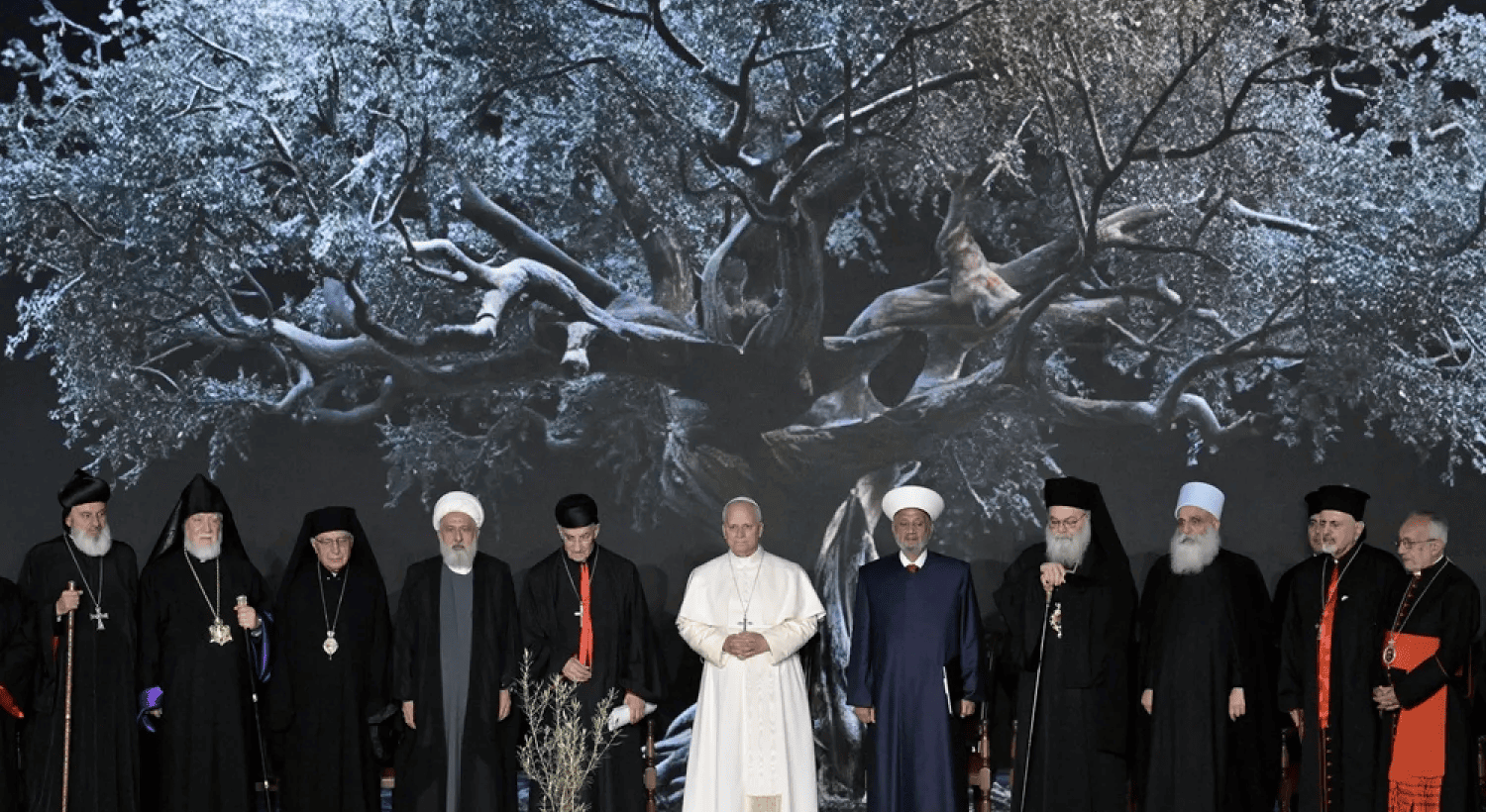
Pope Leo’s meetings with Christian and Muslim leaders reinforced Lebanon’s defining identity: coexistence. In a region often defined by division, Lebanon remains one of the few places where diverse faiths share both space and history. His message was clear, Lebanon’s pluralism is not a weakness, but a model.
By gathering religious figures across sects, the visit underscored a truth many Lebanese hold dear: unity is not achieved by erasing differences, but by honouring them.
There was something deeply unifying about watching the country respond together. Different regions, different communities, different prayers, yet one shared moment. For once, the divisions that so often dominate conversation felt smaller than the shared heartbeat of the people. The visit did not belong to one group. It belonged to Lebanon itself. To its memory, its resilience, its stubborn belief that living together is still possible.
A Message to the Youth: Stay, Rebuild, Believe
One of the most powerful moments of the visit came during Pope Leo’s address to Lebanese youth at Bkerke. Speaking to a generation shaped by crisis, he acknowledged their fatigue and uncertainty.
Rather than offering unrealistic promises, he encouraged them to remain connected to their homeland, not necessarily by staying physically, but by preserving its culture, values, and spirit wherever they go. For many young Lebanese, his words felt like recognition from a world that too often overlooks their struggle.
A Sea of Faith at the Waterfront
The Papal Mass at Beirut’s waterfront became one of the most powerful images of the visit, drawing more than 150,000 people into a single shared moment of prayer. From families carrying children on their shoulders to elderly worshippers leaning on one another for support, the gathering reflected the full spectrum of Lebanese society. The sea behind the altar seemed to merge with the sea of people before it, a nation standing shoulder to shoulder despite its fractures. In that open-air liturgy, divisions of sect, class, and politics dissolved into a collective silence broken only by hymns and whispered prayers. For many, it was not merely a Mass; it was a rare experience of unity, a reminder that beyond the noise of crisis, Lebanon still knows how to gather as one body and one heart.
Honouring Grief, Recognising Resilience
Throughout his visit, Pope Leo paused at sites marked by tragedy, offering silent prayers for victims of conflict and disaster. These gestures resonated deeply in a country where collective grief remains unresolved.
In those moments of stillness, Lebanon’s pain was not analysed or politicised, it was acknowledged.
Perhaps that is what moved people most. Not ceremony, not speeches, but the feeling that Lebanon’s story is still being written. That despite everything, it remains a place where hope is not naïve but necessary. A place where survival is not the final goal, but a step toward living fully again. The visit did not change Lebanon overnight, but it reminded its people of who they already are.
Restoring Dignity on the World Stage
For years, Lebanon has been portrayed internationally through the lens of crisis. Pope Leo’s visit shifted that narrative, even if briefly. Lebanon was seen not as a failure, but as a message: a living testament to coexistence, endurance, and faith.
This visit did not arrive in easy times. Lebanon has been walking through weight. Economic strain, uncertainty, departure of loved ones, and the slow exhaustion that comes from holding on for too long. Yet when the Pope came, people gathered not because life had become simple, but because something inside them still answers when called to hope. Churches filled with worshippers, but also with citizens searching for reassurance that their nation still holds meaning in the global moral imagination. Balconies filled. Screens lit up in homes where silence had been heavy for months. For a moment, the country paused its internal noise and listened together.
Beyond Symbolism: Why the Visit Matters
Critics may argue that symbolic visits do not fix economies or reform governments, and they are right. Yet nations do not survive on policy alone. They survive on meaning, identity, and shared belief.
Pope Leo’s visit did not erase hardship. It did something quieter and more lasting. It reminded people that their endurance is not invisible. That the world still notices a country that refuses to surrender its humanity. Lebanon has known how to rebuild homes, streets, and schools, but rebuilding spirit is harder. For three days, spirit felt lighter. Not healed, not fixed, but strengthened. As if someone had placed a steady hand on a shaking shoulder and said, you are not alone.
Lebanon’s Enduring Message
Lebanon does not endure because it is spared suffering. It endures because its people choose one another again and again. In streets worn by history, in homes filled with memory, in prayers whispered in different languages but rising toward the same sky. The visit simply held up a mirror, and in it, the country saw not only its wounds, but its worth.
And sometimes, that is enough to keep going.