
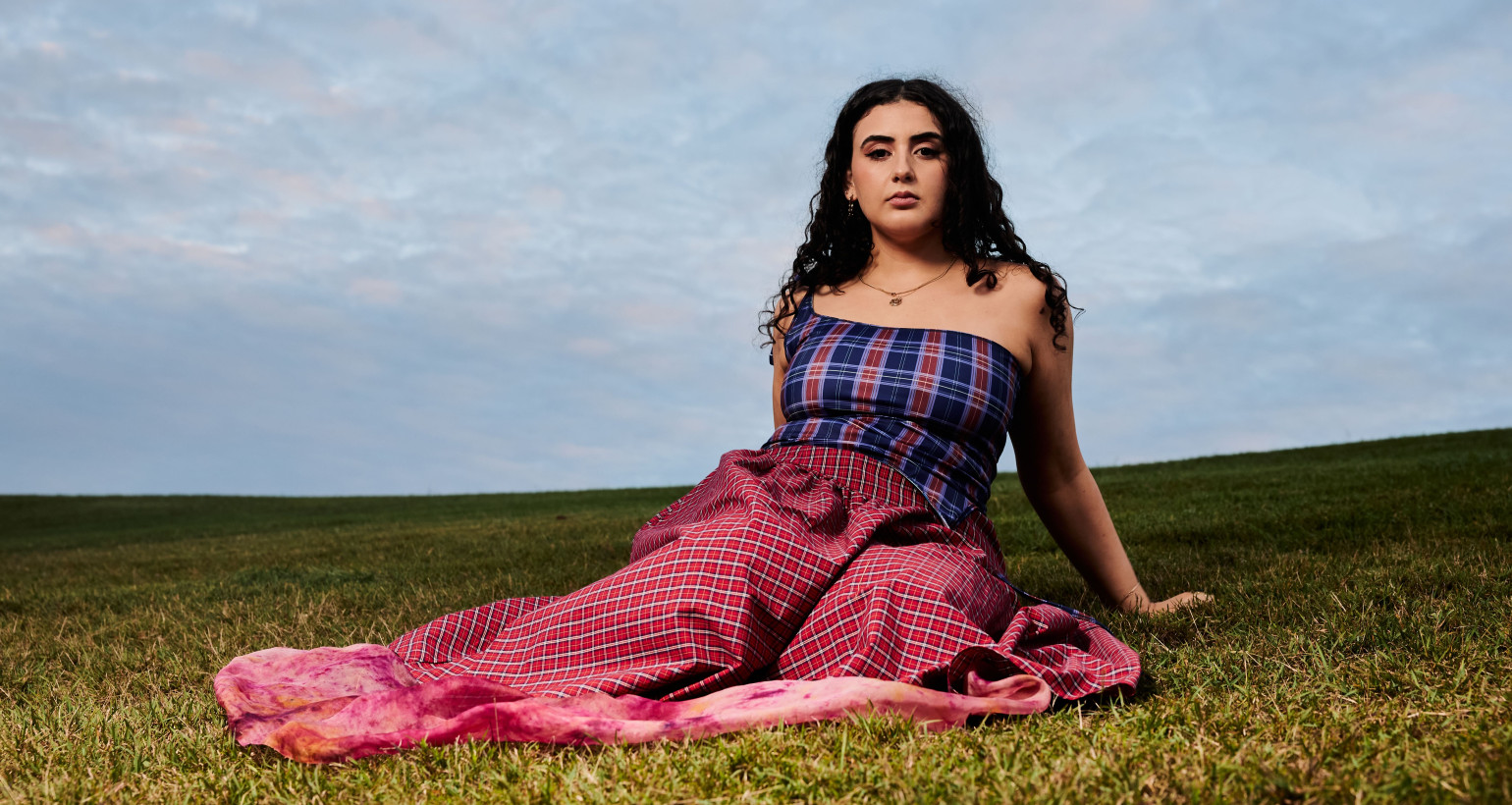
Bringing It Back: Lebanese Australian singer-songwriter Nicole Issa on the relationship between life and art
By Marcus Khoudair
It’s a prolific season for Lebanese Australian artist Nicole Issa. In addition to managing and facilitating socially-driven arts workshops for young people across Sydney’s west, and co-producing a short film proof-of-concept for an upcoming feature film—Nicole launched her career as an indie-pop singer and songwriter with her debut EP Bring It Back to Me, released on July 31st 2026. The result is an honest voyage through years of love, heartbreak, mourning, illness, and self-discovery, powered by layered harmonies, hand percussion, and melancholy synths. In a time of such success, Nicole not only draws inspiration from the people who remain closest to her ‘inner child’, but sees their own successes anew.
“I think my jhidu is the most successful person I’ve ever known,” says Nicole, with her signature vibrant intimacy, “because he’s the most content with what he’s done.” It’s a realisation that came to Nicole after a recent family holiday, their first. Filming skits with her baba, whose presence on camera rings of paternal calm, Nicole saw a man grateful to indulge his daughter’s eccentric ideas—because he was simply content to be with his children, on an unfamiliar street, reaping the reward of decades of his labour in their name. This same gratitude was in Nicole’s jhidu, who was “grateful to Australia, grateful to educate his kids, to own his house”, and who even forbade Nicole from asking RPA hospital staff to turn up the aircon while he was being treated for COPD: “be grateful this hospital exists”. What anchors such contentment? According to Nicole, it was her tayta. She “steered” the family with surrender, devotion, and cheek, answering “what’s for breakfast tomorrow?” with “God willing if I’m awake then, we’ll work it out.”
Away and at home, family is a motif for Nicole. It anchors her, particularly now, through the demands of aspiration and artistic compulsion. While Nicole attracted head-turning praise from Maya Beth on BBC Radio 1, who described Nicole’s first single ‘Shadow’ as a “hug in song”, the need for family comforts are never replaced by new excitements. By the end of their first week in Japan (the place of her favourite world cuisine), Nicole was asking “where’s my olive oil? I just need my olive oil”. Nicole knows what she needs to be nourished. That life intuition motivates her art too. “I hope this small part of my story brings joy to other people’s lives,” pledges Nicole, “I want people to tell me they’ve listened to my music. Not passively.”
Nicole describes Bring It Back to Me as “a four-year journey of my heart and soul”, drawn from the deep well of herself with “curation and weight”. There are echoes in Nicole’s EP of the confessional poetry of Sylvia Plath, even the journalist’s journals of Helen Garner, albeit with the wide-eyed and folky youthfulness of singers like Gracie Abrams. Nicole pulls far and wide to inform her practice, even into the past, returning lately to her kindergarten report cards, to the “unapologetic Nicole before the world told her she had to mask.” That came in adolescence, when Nicole dyed her hair blonde, hung out in Newtown, and told people she was from Ashfield. “When I cried, it was too loud. When I laughed, it was too big.” But when she expressed the sheer size of the emotions she felt through music, what was the response that Nicole got? “Wow.”
Balancing this “reliance on external validation” with the “need to look more internally”, Nicole’s aforementioned desire for an active public listenership is, in truth, her walking the walk—because she so actively listens to herself. And, in a world of consumption and speed and routine, she wants everyone to do the same. Among Nicole’s most stirring lyrics is her clarion call to “refuse your reality”. Is she addressing herself in the mirror? Or advising someone in the crowd and on the other side of a pair of headphones? Either way, Nicole explains that the meaning of this lyric lies in “refusing the expectations people have on you, which you then have on yourself”. It’s an insightful way to define reality. We are, and live inside, expectations.
But such an idea can be as disempowering as it is empowering, depending on the season of life we are in. Thus the natural introspection of Nicole’s music is an invitation to turn to our elders. If my reality is what I expect and how I am expected to be, then the source of those expectations is a vital question for the quality of my life. Consider this in the hands of elder singer-songwriter Dolly Parton, recently passed, on her 1969 classic ‘Coat of Many Colours’, a tribute to maternal love and resourcefulness: “One is only poor if they choose to be / Now I know we had no money, but I was rich as I could be / In my coat of many colours my mama made for me”. Our predecessors give us talismans for the journey, which we clothe ourselves in, and the oral storytelling of Nicole’s Lebanese upbringing and culture is where she derives hers, and her sense of herself now and into the future, as an oral storyteller.
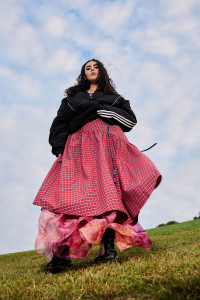
So, that question dreaded by every artist, what’s next? Once again for Nicole, it’s about bringing it back. A few weeks ago, Nicole was in the car, listening to a great among elders. Fairouz. And it was not a passive listen. “I’ve listened to Fairouz all my life. But it’s like I was hearing her for the first time.” Fairouz was confiding in Nicole that she worries her country will forget who she is, and told Nicole to take her back. For another voyage, as honest as her EP, and where her next music might just be born: Nicole pines to go back to Lebanon with her baba, together for the first time. “I want him to take me around,” she says, “to show me what it’s like.”